
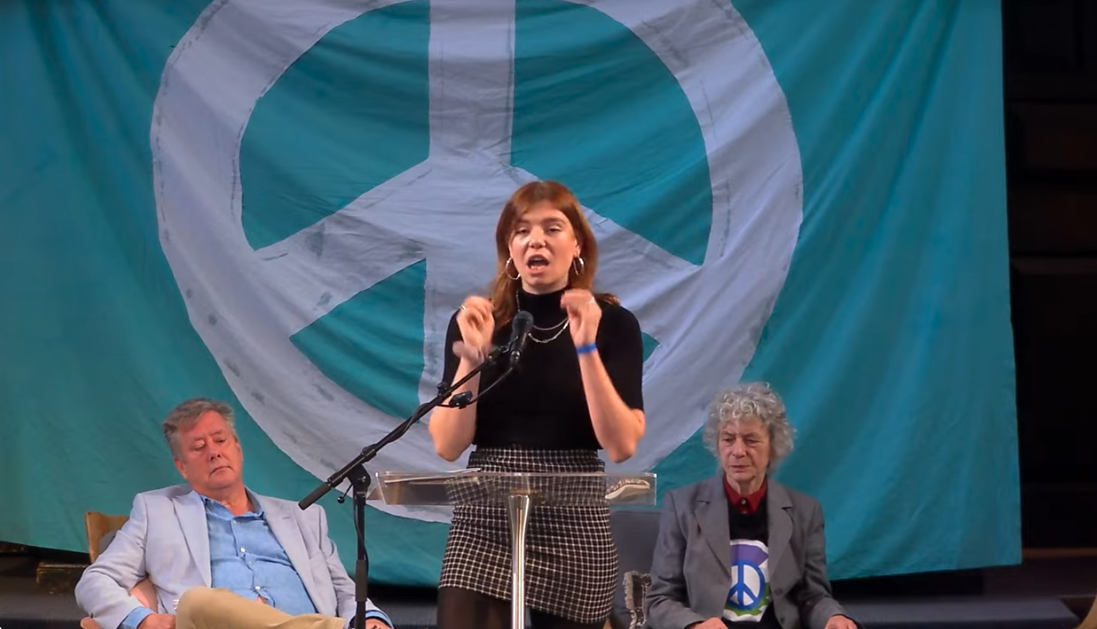
“Hands up if you think it’s nuclear war?”
Edited version of the speech given by Friends of the Earth Scotland movement building lead Kate Whitaker to the Scottish CND conference “Stop the Nuclear Nightmare: Build Scotland for People and Peace” on 1st November 2025
When I was asked to speak today, I quickly searched ‘nuclear and climate change’, to see what people were saying.
What I found was several articles debating whether nuclear war or the climate crisis is the biggest existential threat to humanity.
Hands up if you think it’s the climate crisis?
Hands up if you think it’s nuclear war?
Hands up if you think that debating which existential crisis is going to wipe out significant amounts of humanity first isn’t a great way to stop either of them happening?
This is what I think.
We are facing multiple interwoven crises. Yes, the climate crisis, biodiversity collapse, increased militarism and the nuclear threat. And also deepening inequality, a mental health crisis, a crumbling health service and cuts to public services.
We don’t need to tell people things are bad right now, they already know. I would argue it’s not particularly strategic to do so. “Here’s another bad thing you hadn’t thought about” isn’t a great way to get people to keep listening. instead we need to build an alternative vision of the future, and the hope and power that will make that possible.
There are loud voices who are successfully harnessing the valid fear, frustration and suffering that many are experiencing. And those loud voices are weaponizing this against the most marginalized in our society.
The people who cheerlead Israel’s genocide of the Palestinian people, are the same people who are leading the attacks on refugees, disabled people and trans people.
They are the same people who are calling for the roll back our climate commitments and pushing ahead with new fossil fuel projects.
And, they’re usually the same people who would lose out from policies that would actually address these fundamental issues – from taxing the rich to public ownership to a fast and fair transition for the workers in weapons and high carbon industries
And they’re also the ones who are most concerned about a united movement, with the power to bring about those changes.
This week the “storm of the century”, hit the Caribbean. Storm Melissa was the strongest hurricane since records began, with sustained winds of up to 185mph. The storm has killed at least 50 people in Jamaica and Haiti, with whole neighborhoods flattened and many people still unaccounted for.
As Mikaela Loach, a Jamaican/British climate organizer has been saying this week – this is not a “natural” disaster, this is the direct consequence of the fossil fuel economy. She has argued this storm should not be named Melissa but Darren after Darren Woods the CEO of Exxon, or Wael after Wael Sawan the CEO of Shell.
We could reasonably also say this is the direct consequence and responsibility of those pushing increased militarism and weapons stockpiling, as this accounts for over 5% of all global emissions. And those figures are not even taking into account the emissions from those weapons being used and war itself.
We can’t talk about war and militarism, without thinking about the conditions that create them. The worsening climate crisis is building tensions around water, agricultural and even livable land. The struggle for, and uneven distribution of resources can quickly produce and worsen violent conflicts. This is a continuation of colonialism – where powerful companies and countries are continuing to exploiting resources for their own gain at the expense of local communities. And they often use moments of tension and conflict to expand this extractivism.
In Sudan and the Congo, mining for the metals used in our technology is fueling bloody conflict. In Palestine, the Israeli government sold licenses to drill for gas off the coast of Gaza to Dana Petroleum, an Aberdeen based company in late October 2023 as they were increasing deadly attacks on Palestinian people.
Keith you said that the Scottish govt is building a new wellbeing nations but 1/3 of Scottish households are living in fuel poverty. We are heading into yet another cold winter where temperatures will plummet, bills will rise and most of us are living in leaky, poor-quality homes.
Our reliance on fossil fuels ties us into the volatile global gas market, we have seen how this is impacted by rising militarism as bills skyrocketed after Russia’s invasion of Ukraine.
Meanwhile those same fossil fuel companies continue to rake in billions in profit. $33 billion for Exxon and $23 billion for Shell in 2024.
As CND rightfully pointed out at Labour Conference, it will cost at least £205 billion to renew the Trident nuclear missiles.
There is money for the solutions to these intersecting problems, but it is in the banks of billionaires and the budgets for bombs.
We know what these solutions are – investing in clean energy, in public transport, in good green jobs, in insulating homes. It is in reducing mineral mining through reducing demand and in supporting those countries and communities least responsible for the climate crisis to adapt and prepare.
I would say to Keith and the SNP, if you care about increasing militarism, you must do more to address the climate crisis. Reject new fossil fuel projects, like the second gas power station proposed in Peterhead.
Urge John Swinney to speak out against the Rosebank oil field. Stop leaving our energy transition in the hands of private companies who as we’ve seen will abandon workers at the first opportunity.
Prepare & deliver real plans to create new jobs in renewable energy and supply chains. When public services are crying out for cash, support taxing the energy giants who are profiting from fuel poverty and climate breakdown.
And for the rest of us, we need to build a connected movement, that has a clear and convincing vision for how things could be different. That speaks to the needs and realities of our communities and takes seriously the work of building power. Let’s make our movements welcoming, make space for differing opinions and tactics without splintering. Identify the common targets, hold them to account and advocate for shared solutions across all of these issues.
On the 15th November we will be marching in Glasgow as part of the Global Day of Action during the COP30, UN Climate Summit. Migrant justice, Palestine solidarity, youth groups, trade unions, nature organisations and more are organising together. A march alone doesn’t change the world, but solidarity and collectivism does.
We will come together reject the division and to declare that a better world is possible.
But the only way that is possible is for us to come together and take it.
I want to end by quoting Abeer Butmeh, the coordinator of Friends of the Earth Palestine. As attacks continue in Gaza and the West Bank during the so-called ceasefire her words from last year remain essential.
To tackle the climate crisis, nuclear escalation and militarism, we have to end the logic that some people and places can be sacrificed for profit and imperial power. Not Scottish households living in fuel poverty, not refugees, not the people of Palestine.
Abeer said: “The complicity of Global North governments in Israel’s crimes illustrates what many frontline communities in the Global South go through in terms of climate violence. Peoples and lands are sacrificed to protect the profits of powerful elites and big corporations. It is now more important than ever for climate policy to reflect the exceedingly strong ties between climate change, corporate impunity and colonialism. We demand a ceasefire now, an end to the genocide and a free Palestine. There is no climate justice without Palestinian liberation.”