
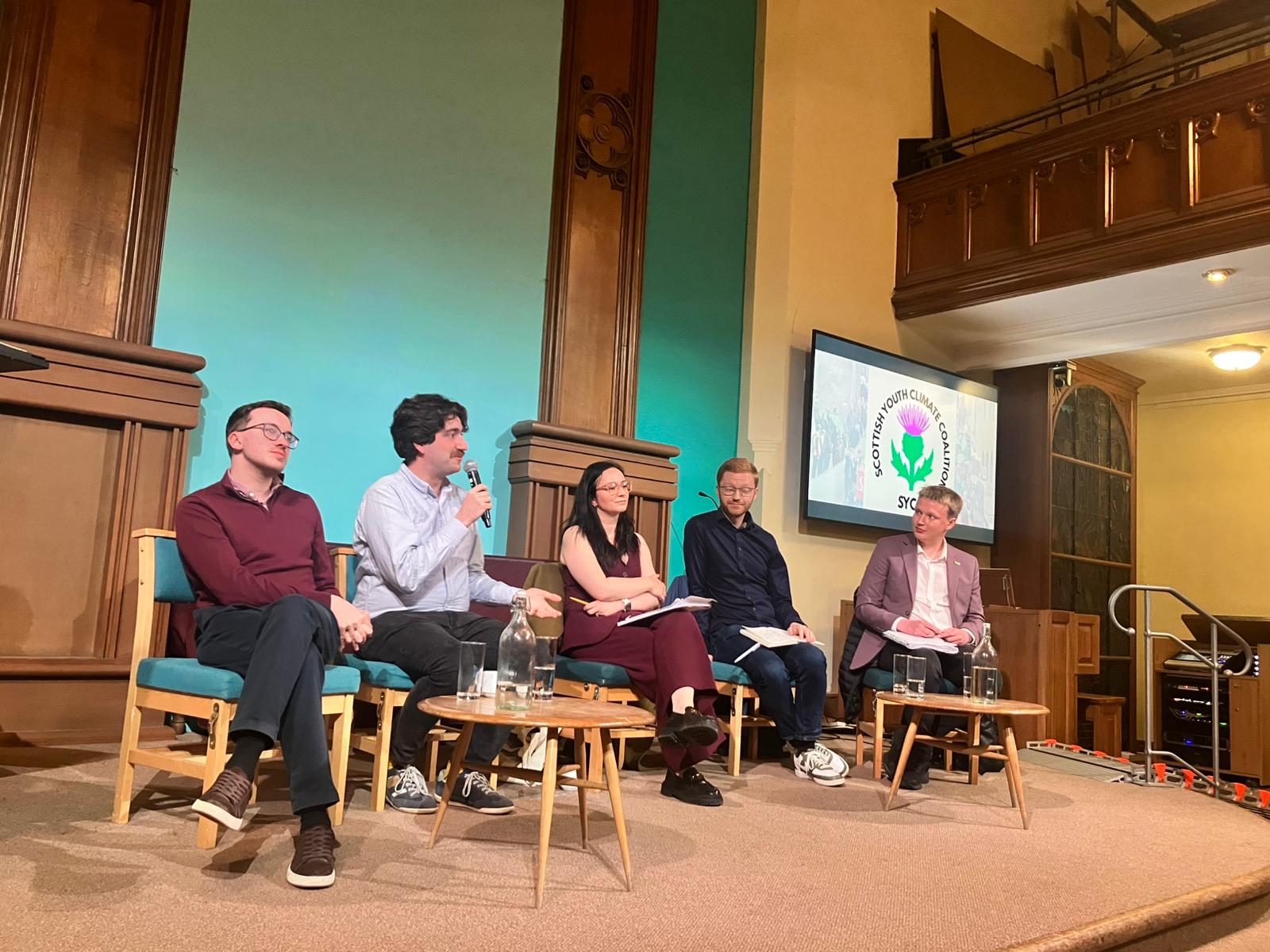
Young people across Scotland unite to grill political candidates on climate change
By Kyle Downie (YFoES), Alyson MacKay (2050 Climate Group), & Charlotte Wilson (Teach the Future)
On Wednesday 22nd April over 100 young people gathered in Edinburgh and online to put tough questions to political hopefuls.
The hustings were organised by the Scottish Youth Climate Coalition (SYCC), a new collective made up of YFoES, 2050 Climate Group, Teach the Future Scotland, Young Sea Changers Scotland, Green New Deal Rising, and People and Planet Edinburgh. Two thirds of young people report feeling worried about climate change, with a similar number saying they don’t feel their voices are listened to by decision makers.
The candidates were:
- Euan Blockley, Scottish Conservatives
- Lewis Younie, Scottish Liberal Democrats
- Eleanor Ryan-Saha, Scottish Labour
- Ross Greer, Scottish Greens
- Ross Clark, SNP
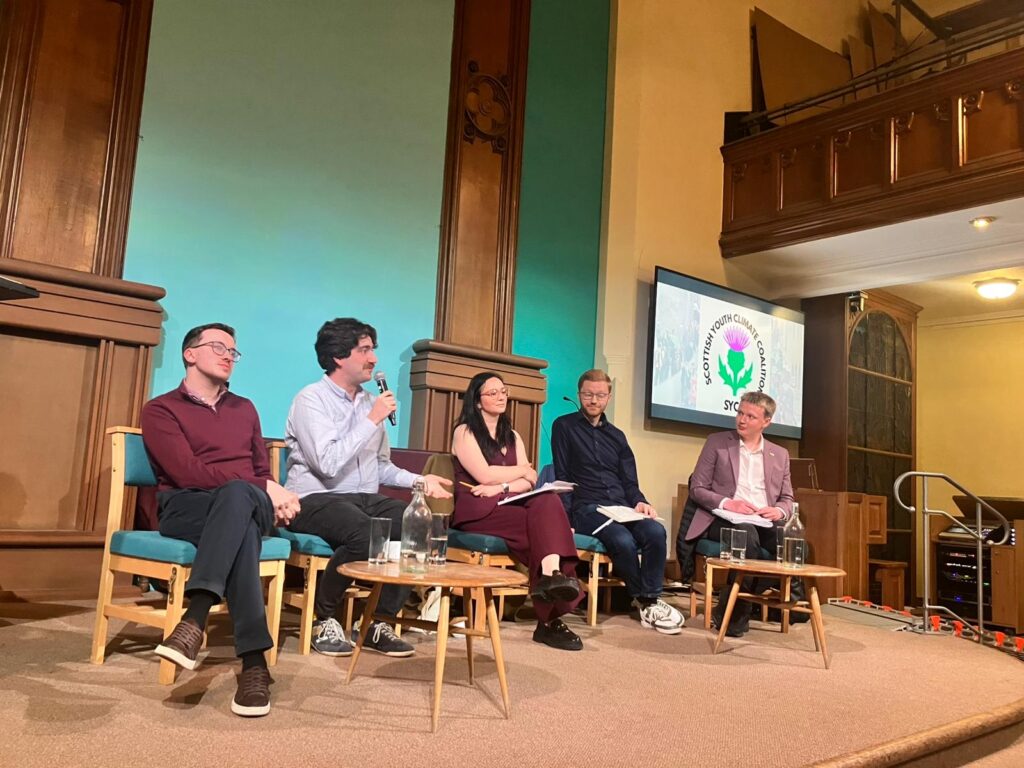
The night started off with brief opening statements from the candidates. Each talked about what they and their party want to do if they win the Holyrood elections on 7th May.
We then went to questions from the Youth Coalition based on our five focus areas. These are areas of policy that we believe are of significant interest and importance to young people in Scotland. These are:
- Education and Employment
- Energy
- Transport
- Marine Environment
- Circular Economy
(You can see the full list of the Scottish Youth Climate Coalition’s demands at the bottom of this article. )
Questions for the candidates
Our first question came from Charlotte Wilson, Campaign Organiser at Teach the Future Scotland;
“To what extent do you think the Scottish education system should centre sustainability, and how could this support a just transition?”
The second question was from Alyson MacKay, Operations Coordinator at 2050 Climate Group;
“How can we deliver an energy transition that lowers energy costs, strengthens community ownership, and gives young people a voice in their energy future?”
Next came a question from Tamsin Wake, volunteer with Young Friends of the Earth Scotland;
“Will you push the Scottish government to support regional transport authorities to take buses back under public ownership so they can run for people rather than profit?
Then we had a question from Louis Macmillan, volunteer with Young Sea Changers Scotland;
“Scotland’s Marine Assessment 2020 concluded that the health of Scotland’s marine environment is in decline. What are three things your party will do to protect and restore Scotland’s marine biodiversity?”
And finally, we had a question from Lily Henderson, volunteer with Young Friends of the Earth Scotland;
“Corporations are responsible for upholding a throwaway culture that leads to mass waste, especially through the non-essential use of critical minerals. What will you do to hold them to account?
Challenging climate questions from the audience
We then went to a quick comfort break before coming back to audience questions. Unfortunately, we only had time for seven questions from the audience, but they were all great.
We started with a question about Scotland’s colonial past and climate reparations. The next question came from the youngest member of our audience (11 years old) who asked the candidates, “if you could change one thing the government has done this year, what would it be?” An amazing question that really stumped the candidates.
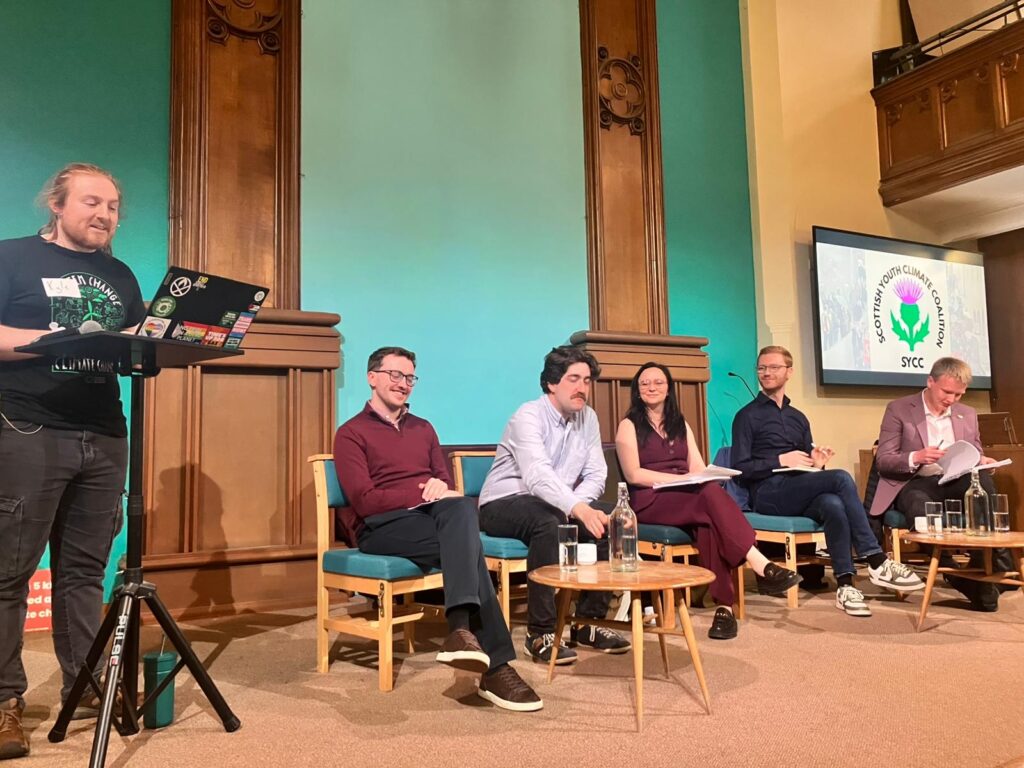
Next up the candidates were challenged about geo-engineering, specifically carbon capture and storage (CCS), and solar radiation management. Most of the candidates admitted to not knowing much about these concepts, though most did commit to supporting CCS – despite it being a technology that has proven time and time again that it does not work, and it often used as an excuse by fossil fuel companies to continue their extractive and damaging activities.
The fourth audience question was related to food, pointing out that agriculture is one of Scotland’s biggest sources of emissions and that it takes a massive amount of land. The next question came from a member of Project Sea Grass who asked what parties would do to tackle pollution from agriculture and sewage that is damaging sea grass meadows, and how they will support healthier and cleaner waters in Scotland. The last question asked the candidates if their parties would expand the use of Citizen’s Assemblies to increase and improve direct democracy.
Watch the debate
We want to encourage everyone to fact-check everything that was said by the candidates at the hustings. If you weren’t able to attend, please check out the recording of the night on the Friends of the Earth Scotland and 2050 Climate Group’s YouTube channels.
More action to take
The hustings may be over, but the youth election campaign is far from done. We are now focusing on our Candidate Climate Cards campaign. With this, we are seeking to help young people to engage with their own candidates.
To take part all you need to do is send an email to your candidates with a form they can use to answer a set of questions. These responses will then be graded like a school report card on a scale of 1-5.
If you want to get involved with the Scottish Youth Climate Coalition, you can email SYCC@2050.scot
Scottish Youth Climate Coalition Demands
Scottish Youth Climate Coalition demands for the next Scottish Parliament are:
Energy
- Youth representation in community energy projects, involvement in local planning and governance structures, and creating pathways for young people to help design the energy system they will inherit
- Shift from hosting renewables to partnerships to allow young people to share in the value generated by renewable developments. Prioritise community and co-ownership models to localise revenues, fund community priorities and create long-term investment for future generations.
- Reduce energy costs and tackle fuel poverty through energy efficiency and home retrofits, smarter energy use and local energy services, and reinvesting revenues from renewables to support vulnerable households.
Education and Employment
- Holistic cross-curricular Learning for Sustainability (LfS), with mandatory LfS training for all staff, LfS leads in each school, and LfS as a central part of inspections
- Funding and a detailed delivery plan to fully decarbonise all schools by 2035.
- Free, accessible green skills training, retraining and job pathways shared via an online directory, along with a green jobs guarantee, to empower people from all backgrounds and sectors to drive the green transition.
Transport
- Support unrestricted green travel for young people by extending free buses to under 30s, reducing the reliance on private transport.
- Incentivise people to use public transport by introducing a national £2 bus fare cap.
- Scottish Government to encourage regional transport authorities to take buses back under public control.
Marine Environment
- Commit to protecting sensitive species and habitats by banning destructive fishing (including bottom-trawling and dredging) practices in Marine Protected Areas (MPAs).
- Reduce sources of pollution by imposing strict regulations, penalties and targets for sewage, agricultural and aquacultural sectors as well as banning/limiting single use and harmful plastic products.
- Ensure every young person grows up understanding how their actions affect the sea and why a healthy marine environment is important for them by embedding ocean and climate education into the school curriculum.
Circular Economy
- Close the loopholes in the ban on new incinerators, including blocking the 6 incinerators planned to be built in the next parliamentary session.
- Scottish Government to work with the UK government on a new business, human rights, and environment (fairer supply chains) law to make it as strong as possible.
- Use circular-economy measures to reduce our consumption of products containing forever chemicals by introducing/improving circular economy measures to minimise overall production.