

Making sense of the Scottish Parliament vote on data centres
What the hell happened with data centres this week?
If you’re feeling confused by the AI data centre rollercoaster over the past few days, you’re not the only one. We’ve seen parliamentary debates, surprise Scottish Government announcements, emergency email actions and a result that has left some people unsure on what’s next. Let’s break it down:
So, what actually happened yesterday?
On Wednesday 16 September the Scottish Greens tabled a debate and vote on a motion calling for a moratorium on AI data centre plans. Over 20 proposals for monster data centres have popped up across the country and are being rushed through the planning system in Scotland without proper consideration of social and environmental impacts.
Every political party put in amendments (changes to the wording of the motion), but only Labour’s included a call for planning decisions to be delayed until guidance was published. During the debate, many MSPs raised concerns about data centre plans in their own constituencies and the question of whether local councils should be left to make unguided decisions with national implications was raised several times.
In the end, the majority of MSPs voted in support of a composite motion that replaced the Greens’ call for a moratorium with watered down concessions.
This included supporting proposals for the Scottish Government to publish the guidance much sooner – by the end of this year – and said the guidance will cover requirements for data centres to minimise energy and water impacts. The SNP, Scottish Labour and Liberal Democrats voted for the motion; Conservatives and Reform voted against it and the Scottish Greens abstained.
Crucially, the motion they passed says that until this guidance is published, no decisions on planning applications should be made.
In a separate statement, the Scottish Government also said yesterday that no data centres would be approved in Scotland without an environmental impact assessment (EIA), which is needed to understand what impacts these data centres will have if built, but wasn’t previously required.
As the dust settles on this key debate, it is emerging that there is still a lack of clarity on the Scottish Government’s position, with questions being asked in Parliament again the day after the vote about whether data centres could be approved before the end of the year. The Scottish Government repeatedly said it was ‘unlikely’ that any data centres would be approved before Christmas but refused to use its powers to create certainty on this matter.
What does this really mean?
Undoubtedly, this is a significant step forward to be welcomed. Allowing any of these developments to go ahead without environmental assessments would be scandalous.
As MSPs voted in favour of planning decisions on AI data centres not being approved until the national guidance is published, which is expected by the end of the year, this sends a strong signal to councils who were due to make planning decisions soon.
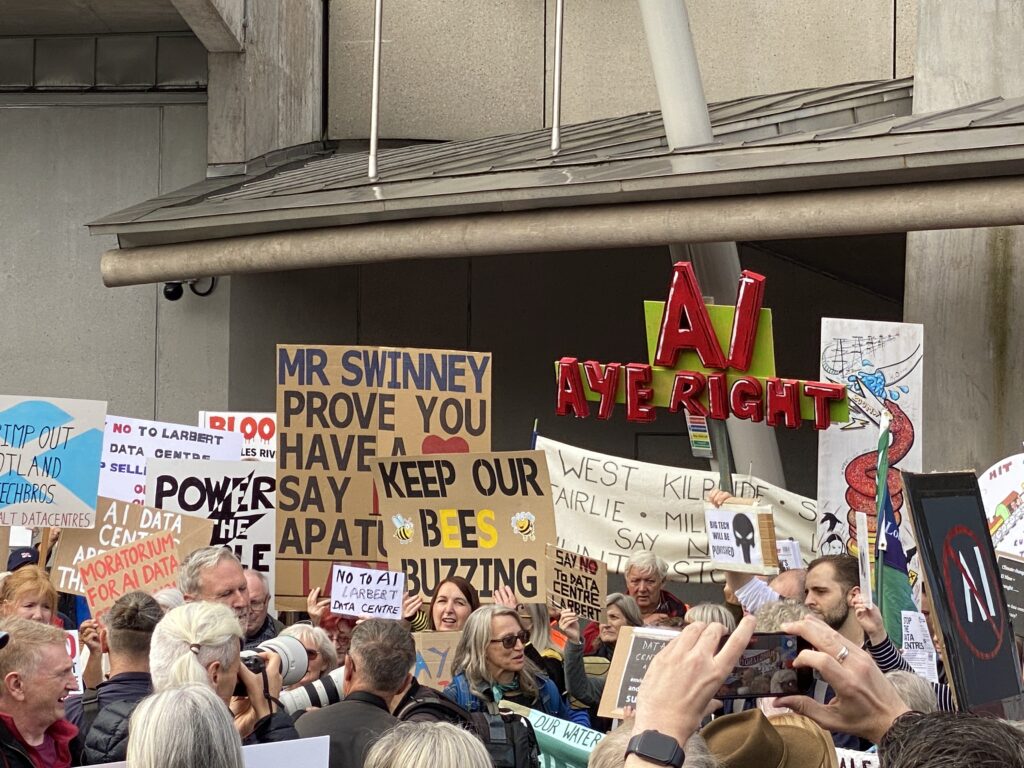
This shift also shows people power works. The government has been reluctant to act, but the community and campaign groups have become too hard for it to ignore. Just this week over 8000 emails were sent to MSPs through our online tool alone!
However, it’s so important we don’t stop now.
A motion is a non-binding statement used to raise awareness and call to action. This means the vote yesterday was largely symbolic. It also fails to include some important details, such as the need to define what a “green” data centre is and no mention of the huge amount of critical minerals that data centres will need, which is an important but overlooked concern. In addition, EIAs measure but don’t minimise impact, so making them a requirement doesn’t force plans to be environmentally safe.
A moratorium, as it is typically used in Scotland, would mean that the Scottish Government committed to calling in and rejecting any AI data centre proposal. Moratoriums like this have been used before in Scotland to stop destructive development plans, such as fracking and nuclear power.
By watering down the original motion, MSPs removed support for putting in place legal mechanisms or powers that would ensure AI data centres do not go ahead without new safeguards – which are needed to minimise the social and environmental impacts.
The Government has said they don’t ‘expect’ any AI data centre plans to be approved before Christmas, but has repeatedly refused to commit to the powers that would make this happen, for example a policy of “no support” for applications, or calling in any that are submitted.
While several developers now have to go back to the drawing board after the requirement to submit EIAs, we can’t rely on an expectation or assumption that no more applications will come in.
In failing to make their position clear, MSPs and the Scottish Government have missed an important opportunity to firmly put the people of Scotland before the billionaire tech bosses who are driving the demand for data centres across the world.
What happens next?
Communities affected by data centre plans across Scotland have been organising, making their voices heard and protesting for months. It is exactly this pressure that led to MSPs and the Scottish Government making some progress towards tightening planning around data centres yesterday – people power is working!
In the coming months, it is super important that we don’t let the Scottish Government forget about the threat that big tech-powered mega data centres pose to communities, the environment and our climate. Let’s use this time to keep building an unignorable movement for change.
The Scottish Government needs to go further than warm words and bring in a full and firm moratorium on AI data centre plans, clearing up the uncertainty it has created.
This issue requires more discussion than planning guidance: we need to deeply debate what the need for AI data centres is in our society and be led by that – not big tech’s rampant desire for profit. This requires a national conversation on AI data centres and a public consultation so that people can have their say democratically. This must happen before any data centre plans are approved, to make sure the decisions reflect what is right for Scotland and put people and nature first.
Want to continue to be part of the fight against AI data centres? Join Friends of the Earth Scotland as a member today.