
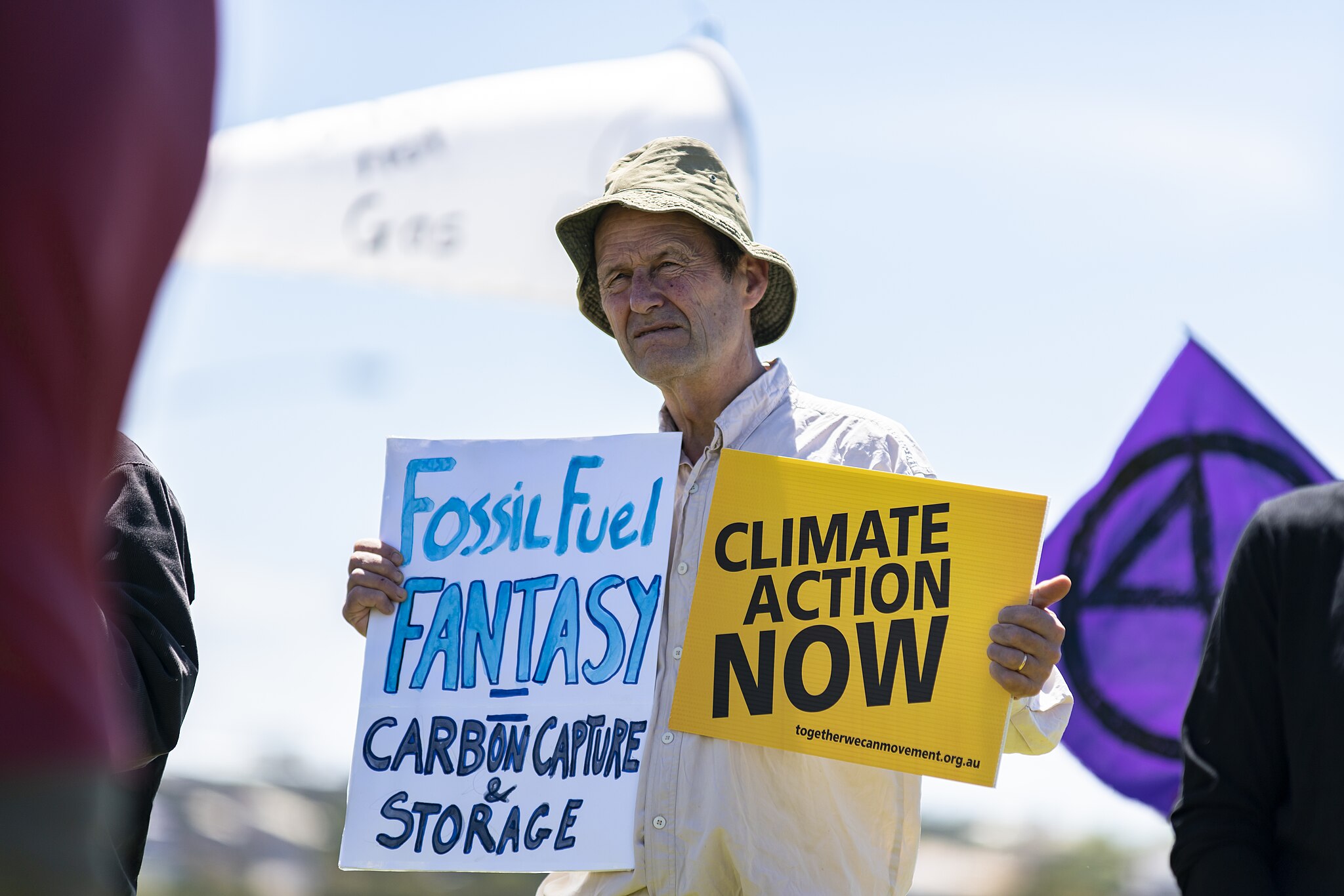
Carbon capture climate warnings ignored by Scottish Ministers
The Scottish Government has ignored repeated warnings on the Acorn project and is putting its climate commitments at risk by continuing to rely on ‘the fairytale of carbon capture’, say campaigners.
The Acorn project has been at the centre of a ‘funding farce’ since the UK Budget with both UK and Scottish Governments claiming to back the unproven technology, despite cutting and withholding subsidies. Now climate campaigners are saying that the Acorn project is ‘in serious trouble’ and highlighting concerns about the ability of carbon capture to ever deliver on the claims of its developers.
The lead developer of the Acorn project, Storegga, announced it was pulling out in December 2025 but has not been able to sell its stake to another investor.
Scotland’s Climate Plan states that carbon capture and similar “negative emissions technologies” (NETs) could deliver up to one third of Scotland’s climate pollution reductions by 2036, but there has been zero carbon stored so far. NETs are speculative technologies that proponents claim will draw down carbon dioxide from industrial processes or the atmosphere, with the hope it can be permanently stored.
In 2021, Holyrood committees scrutinising the 2018-2032 climate plan update urged Ministers to come up with a ‘Plan B’ to meet climate commitments without using carbon capture, if the technology failed to materialise. There have already been two failed CCS projects in the North East in 2011 and 2015.
In February 2026 the UK Climate Change Committee of advisors warned Scottish Ministers that their new Climate Plan’s ‘heavy’ reliance on negative emissions technologies represented ‘an area with significant risk’ and powers to deliver on these policy levers were ’largely reserved to the UK Government.’
Carbon capture technology has a long history of failure despite receiving over USD$ 30billion in subsidies globally. The entire global industry is only capturing around 0.1% of total global emissions.
Friends of the Earth Scotland’s head of campaigns Caroline Rance said:
“For too long, Scottish Ministers have been sticking their fingers in their ears when anyone has tried to warn them about the risks of relying on carbon capture. MSPs, advisors and experts have repeatedly said that their entire climate plan was too reliant on this unproven technology to deliver at Acorn.
“Carbon capture has failed everywhere it has been tried at scale and the Acorn project is in serious trouble. The funding farce of the last week exemplifies the repeated delays and failures of the so-called carbon capture industry. Despite years of unthinking political support, Acorn has not stored a single gram of carbon.
“The UK Government clearly has major doubts about this project and is rightly indicating that there can be no more blank cheques for it. It is time for the Scottish Government to stop believing in fairytales and instead put time and money into climate solutions that will improve people’s lives such as insulating homes and improving bus services.
“This fantasy should never have been peddled to oil workers, who instead need a credible plan for support and retraining that can move them into truly green jobs.”
MSP reports must mean ‘reality check’ in Government Climate Plan 2018-2032 update ( March 2021)
https://foe.scot/press-release/msp-reports-must-mean-reality-check-in-government-climate-plan/
Progress in reducing emissions in Scotland – UK Committee on Climate Change 2025 report to Parliament (February 2026)
p57-58 of the report states
“the draft CCP pathway has a greater reliance on NETs than the CCC’s Balanced Pathway, reaching an annual average of -2.4 MtCO2e in the Third Carbon Budget, compared to -1.2 MtCO2e in the CCC’s Balanced Pathway. This reflects steeper growth in NETs deployment over the Third Carbon Budget.
NETs is an area with significant risk and with policy powers largely reserved to the UK Government.”
https://www.theccc.org.uk/wp-content/uploads/2026/02/Progress-reducing-emissions-in-Scotland-2025-report-to-Parliament-34378gfhdk928365sjfge.pdf
The Scottish Government Climate Plan imagines Negative Emissions Technologies will be responsible for a reduction of 12.2 megatonnes of emissions reductions in the 2036-2040 carbon budget. Negative Emissions Technologies include CCS, Bioenergy with CCS and Direct Air Capture.
https://www.gov.scot/publications/scotlands-climate-change-plan-2026-2040/pages/10/
Total Scottish greenhouse gas emissions were 39 megatonnes in 2024
https://www.gov.scot/news/scottish-greenhouse-gas-statistics-2024/
Carbon capture subsidies and failures
https://oilchange.org/publications/funding-failure-carbon-capture-and-fossil-hydrogen-subsidies-exposed/